
ADA Automatic Doors & OperatorsInstallation, Repair & Accessible Entry
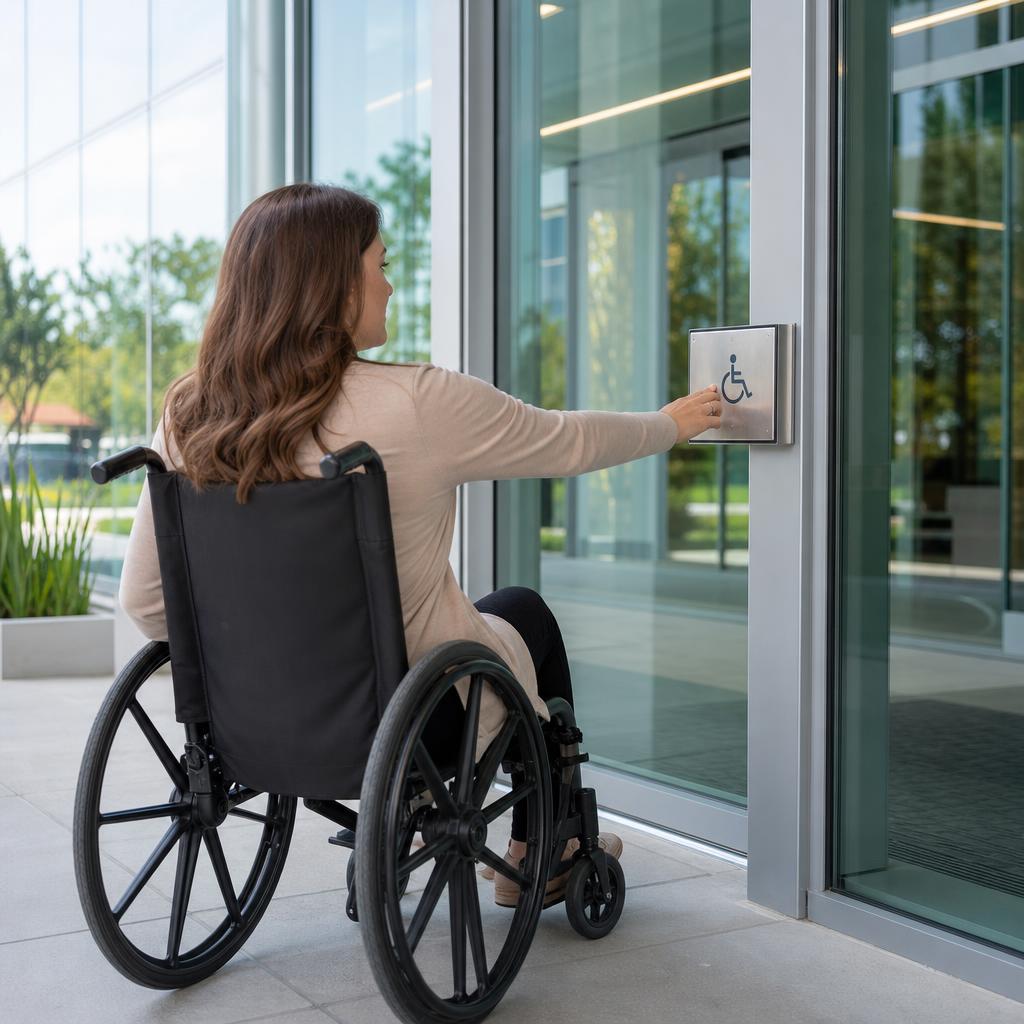
Ensuring accessible entry for all visitors and employees. We repair, replace, and install commercial ADA automatic door operators, push plates, and touchless activation systems.
Common Issues & Indicators
Recognizing changes in an opening can help a facility manager address the problem before the door, lock, or glass becomes unusable.
Failure to Open
The door does not respond when the button is pressed or a hand is waved, indicating sensor, wiring, or motor failure.
Erratic Movement
The door opens partially, closes too quickly, or stutters during operation, potentially posing a safety risk.
Strange Noises
Grinding, clicking, or whining sounds from the operator header suggest worn mechanical gears or a failing motor.
Ghost Operations
The door opens on its own when no one is present, typically caused by misaligned sensors or environmental interference.
Core Capabilities
Practical options for common commercial repair, replacement, and planned improvement needs.
Operator Installation
Surface-mounted and concealed automatic door openers designed for reliable, heavy-duty commercial operation.
Touchless Activation
Installation of wave-to-open sensors to support touch-free activation and accessible entry.
Push Plate Integration
Wiring and mounting of push-button activators planned around the opening layout and project requirements.
System Repairs
Troubleshooting and repairing motors, control boards, sensors, and mechanical arms on existing automatic doors.
Our Process
How we approach evaluation, planning, and execution for commercial facilities.
Diagnosis
We inspect the operator, sensors, control board, and the door's physical swing to locate the issue.
Clearances Review
We review door movement, closing speeds, activation placement, and sensor detection fields.
Component Servicing
Repairing or replacing the affected parts, from worn motor arms to faulty push plate transmitters.
Function Testing
We test activation, door movement, and closing behavior to support the facility's accessible-entry goals.
Repair vs. Replacement
Many automatic door issues can be resolved with localized repairs, though aging complete systems may require replacement.
When to Repair
- A push button's battery has died or its internal switch is broken.
- The operator arm has come loose and simply needs to be re-secured and adjusted.
- Safety sensors have been bumped out of alignment and require recalibration.
When to Replace
- The primary motor or control board has burned out on an obsolete operator model.
- Repeated operational failures indicate the current operator is undersized for the door's weight.
- Upgrading an entire manual entrance to an automated system to meet new accessibility goals.
Facilities We Serve
- Hospitals & Medical Clinics
- Assisted Living Facilities
- Retail Centers
- Public & Government Buildings
- Corporate Offices
Important Considerations
Door Weight & Wind Load
The size and type of the door, as well as external wind conditions, dictate the strength of the operator motor required.
Project Requirements
Accessibility standards, permits, electrical work, and final approval depend on the opening and local requirements and may involve other licensed trades or authorities.
System Coordination
Some openings may need coordination with access-control, life-safety, or building-management systems before installation.
Service FAQs
Common questions about our ada automatic doors capabilities.
Can you automate an existing manual door?
Do you offer touchless wave-to-open sensors?
Why is my automatic door opening on its own?
Do you repair the actual motors in the door header?
Need a ADA Automatic Doors Professional?
Call our team for emergency dispatch where available or to discuss scheduling for planned projects.